

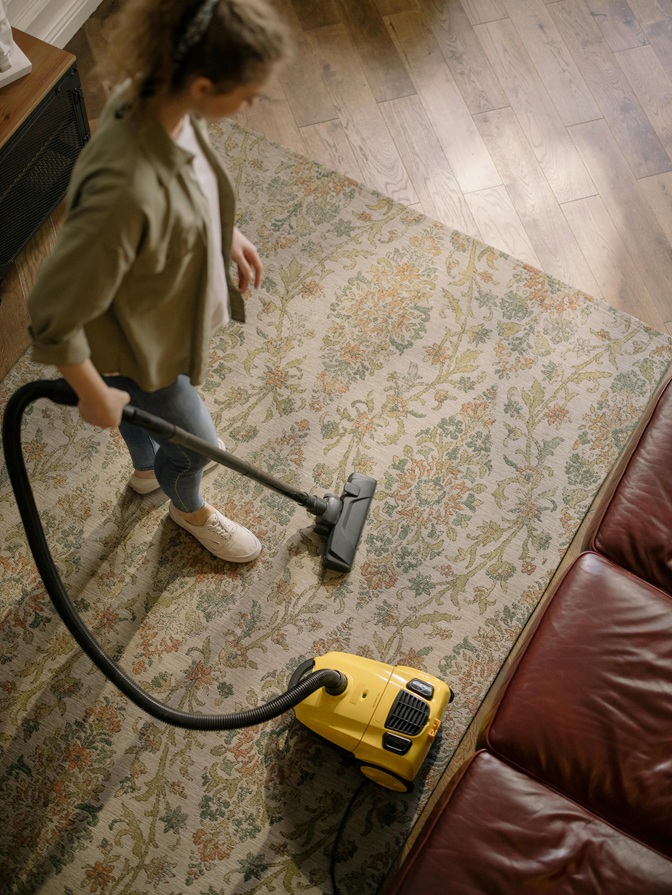
Most homeowners underestimate what DIY carpet drying actually requires — and overestimate what it achieves. The honest answer: DIY works for small, clean, early-caught situations. For anything larger, older, or more contaminated, professional drying almost always costs less than the consequences of getting it wrong. Here is the real comparison.
⚡
DIY drying is appropriate only when: the spill was clean water, the area is under 2 square metres, you caught it within 6 hours, and the underlay is not saturated. Any other situation — call a professional first.
What DIY Carpet Drying Actually Involves
Tools Required
Effective DIY drying is not just opening a window and hoping for the best. To give DIY a genuine chance, you need all of the following:
Hire cost: ~$40–$80/day. Without this you cannot extract standing water from the carpet.
At least two. Household desk fans are insufficient — you need floor-level air movement across the pile.
Hire: ~$70–$120/day. Purchase: $600–$1,200. Removes moisture from air as carpet evaporates.
Hire: ~$50–$100. Without this you are working blind — you cannot tell if the underlay is actually dry.
Realistic Time Investment
Budget for at least 2–3 days of active management: extracting water, repositioning fans, emptying the dehumidifier, and checking moisture levels. It is not a set-and-forget exercise. For a saturated room, that is 20–30+ hours of elapsed time during which your home is disrupted and the mould clock is ticking.
When DIY Is Good Enough
DIY drying is genuinely appropriate only when all four of the following conditions are met:
- ✓
The spill was clean water — Category 1 (burst pipe, tap, rain) - ✓
The affected area is small — one to two square metres - ✓
You caught it within 6 hours and the underlay is not saturated - ✓
You have access to all the right equipment listed above
What Professional Carpet Drying Actually Involves
Equipment Professionals Use (That You Cannot Hire Easily)
The gap between consumer and professional equipment is significant — and it directly determines the outcome:
Moisture Meters and Readings
Professionals use calibrated thermal and pin moisture meters to measure actual moisture content in carpet, underlay, and subfloor — not guesswork. A reading tells you definitively whether the material is at a safe moisture level or still at mould risk. DIY drying without a moisture meter means working blind on the most important measurement.
Structural Drying vs. Surface Drying
The most important distinction:
DIY methods dry the carpet surface. Professional methods dry the entire system: carpet, underlay, and subfloor. A carpet that feels dry on the surface can have a completely saturated underlay and damp concrete below it — a perfect mould incubator for weeks after the event.
Learn more about why underlay is the hidden risk: Wet Carpet Cleaning and Restoration — What’s Actually Involved
Cost Comparison: DIY vs. Professional vs. Full Replacement
The most commonly missed scenario is the bottom row — failed DIY that still requires professional rescue. This is the most expensive outcome and the most avoidable.
| Option | Upfront Cost (Est.) | Risk Level | Best For |
|---|---|---|---|
| DIY (hire equipment) | $150–$350 for 2–3 days | Medium–High | Small, clean, early-caught spills only |
| Professional drying | $500–$2,500 dep. on area | Low | Medium to large damage; any grey/black water |
| Full carpet replacement | $2,000–$8,000+ | Low | When restoration is no longer viable |
| Failed DIY + professional rescue | $350 (DIY) + $1,500–$3,500 | Highest | The worst outcome — mould established before pros arrive |
And far less than a full carpet replacement caused by incomplete DIY.
When DIY Is Not Enough: 8 Clear Signs
If any of the following apply to your situation, stop the DIY and call a professional. The cost of getting this wrong is higher than the cost of professional help.
1
Drain, flood, washing machine overflow — contamination requires professional decontamination, not just drying.
2
Equipment hire costs start to approach professional service costs — with lower results and no moisture verification.
3
The mould window is open. Professional response is the safer choice — mould can begin germinating within 24 hours in Australian conditions. At this stage the situation can shift from a drying problem to a contamination problem, governed by the IICRC S520 Standard for Mould Remediation rather than standard drying protocols.
4
The underlay is saturated and requires professional extraction — DIY fans cannot dry underlay effectively from above.
5
A DIY operation cannot manage drying across multiple spaces simultaneously with the equipment available for hire.
6
Smell indicates microbial activity is already underway. DIY drying will not address contamination — professional treatment and decontamination is required.
7
Concrete absorbs and retains moisture for days. Professional monitoring with moisture meters is the only reliable way to confirm dryness.
8
Children, elderly, asthmatics, or immunocompromised individuals — do not accept the risk of incomplete drying when health consequences are higher. See: Can Wet Carpet Make You Sick?
Insurance Implications: Does DIY Void Your Claim?
Starting DIY drying before your insurer assesses the damage can affect your claim. Most policies require you to report damage promptly and not make alterations before assessment.
In practice, basic water extraction is generally accepted as necessary emergency mitigation — most insurers expect you to prevent further damage. But full DIY restoration (pulling up carpet, replacing underlay yourself) may complicate your claim by removing the evidence an assessor needs to evaluate.
The safest approach:
- 1
Call your insurer first — report the damage and get a claim number before you do anything else. - 2
Get a professional moisture assessment — produces documentation for the claim and establishes the scope of damage. - 3
Proceed with restoration based on the insurer’s guidance and the professional assessment recommendations.
For a full guide on lodging your claim correctly, read: Water Damaged Carpet Insurance Claim: What’s Covered and How to Lodge It
The Professional Carpet Drying Process: Step-by-Step
This is what a certified water damage team does from arrival to sign-off — each step supported by measurement, not guesswork:
Moisture Assessment
Scope the affected area with thermal and pin moisture meters — measures what is invisible to the eye, including subfloor and wall cavity saturation.
Water Category Determination
Clean, grey, or black water — this classification drives the entire treatment plan, equipment selection, and any decontamination requirements.
High-Powered Water Extraction
Truck-mounted or portable extraction units remove standing water and deeply saturated moisture from carpet and underlay in a single pass.
Antimicrobial Treatment (if Required)
Applied where Category 2 or 3 contamination is present. Penetrates carpet fibres and underlay to eliminate bacteria and prevent mould establishment.
Equipment Placement
Industrial air movers and commercial dehumidifiers strategically positioned to maximise airflow across the entire drying system — not just the surface.
Monitoring
Daily or twice-daily moisture readings until all target levels are reached. Readings are documented — useful for insurance claims and confirming the job is done correctly.
Final Inspection and Sign-Off
Equipment removed only once all moisture readings confirm safe levels across carpet, underlay, and subfloor. Written confirmation provided.
DIY not cutting it? We step in where fans and towels leave off.
Same-day emergency service available across Sydney — on-site within the hour.
Frequently Asked Questions
Not sure if DIY is working? Get a professional opinion — free.
We assess, document, and restore — with moisture readings that prove the job is done right.
Emergency Response
On-Site Sydney-Wide
Damage Assessment
Certified Technicians